Number and Operations
Numbers and Basic Operations
Vertical Alignment
TEKS:
| 5th | 5.2(B) |
| 6th | 6.2(C)6.2(D)6.9(A)6.9(B)6.9(C)6.10(A)6.10(B) |
| 7th | 7.10(B)7.11(A)7.11(B)7.10(A)7.10(C)7.11(C) |
| 8th | 8.8(A)8.8(B)8.8(C) |
| Alg 1 | A.2(A)A.3(C)A.3(E)A.4(A)A.4(B)A.12(A)A.12(B)A.2(H)A.3(D)A.3(H)A.5(B) |
| Alg 2 | 2A.6(D)2A.6(E)2A.6(F)2A.3(E)2A.3(F)2A.3(G)2A.4(A)2A.4(B)2A.4(D)2A.4(E)2A.4(F)2A.4(H)2A.7(I)2A.8(A)2A.8(B)2A.8(C)2A.2(A)2A.6(G)2A.6(K) |
Linked To

Downloads
- Download Visual
- Word wall visual
- Lesson Plan
-
Lesson Materials
-
 Teacher Guide
-
 Leveled Reading Passages
-
.svg.png)
Google Drive
Structured Conversation Questions
Observational
What is an inequality?
An inequality is...Relational
How is an inequality different from an equation?
An inequality is different from an equation because...Inferential
Why do you think multiplying or dividing by a negative changes the direction of the inequality?
I think multiplying or dividing by a negative changes the direction of the inequality because...
Please log in to comment.
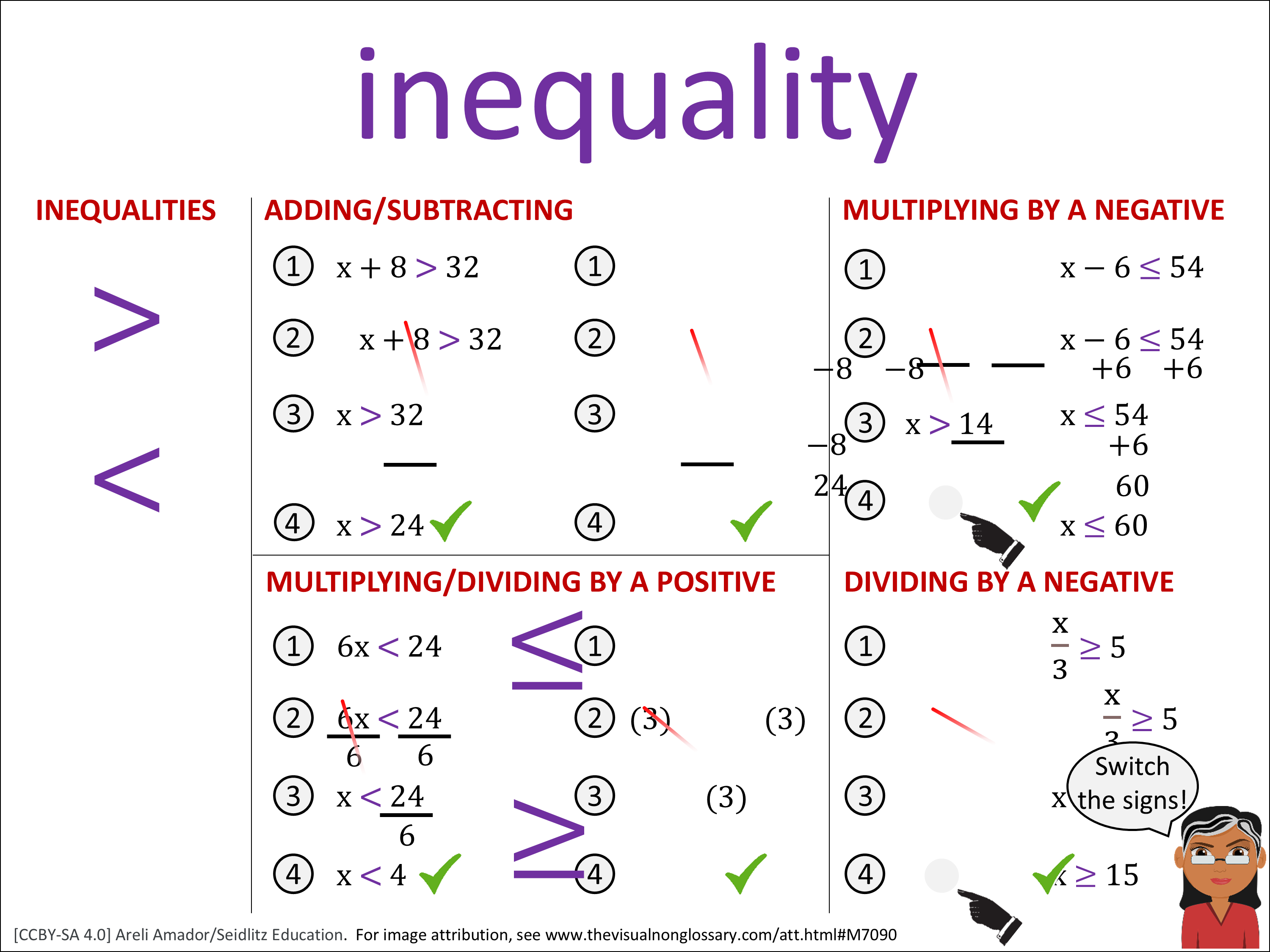
Students might notice in this visual:
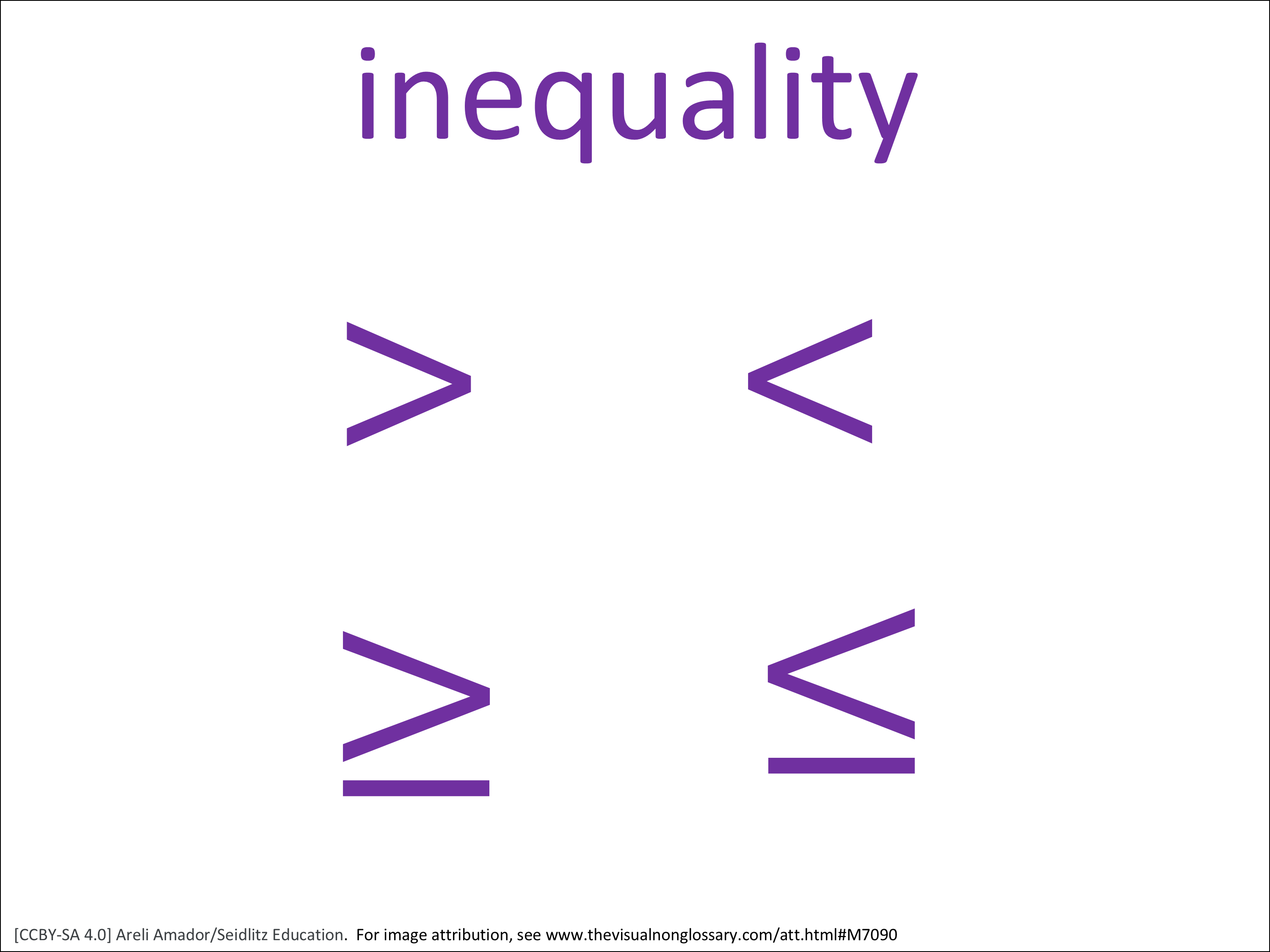
- The symbols show relationships like less than or greater than
- The direction of an inequality can change depending on what you do to both sides
- Multiplying or dividing by a negative flips the inequality symbol
- The same number is being compared on both sides in different ways
- The visual shows patterns between steps and how inequalities behave
EXTENDING THE DISCUSSION
After the observational question, randomly call on one or more students to share what they or their partner answered. Then ask the class, “Did anyone notice…?” using the suggestions above or anything else you’ve noticed.
After the observational question, randomly call on one or more students to share what they or their partner answered. Then ask the class, “Did anyone notice…?” using the suggestions above or anything else you’ve noticed.

Students might wonder:
- Why does multiplying or dividing by a negative change the direction?
- Does the inequality always flip with negatives?
- What happens if you do more than one step?
- How is this different from solving an equation?
- Can an inequality have more than one solution?
EXTENDING THE DISCUSSION
After students have shared what they notice, ask the class, “Did anyone wonder…?” using the suggestions above or anything else you might think is interesting or relevant to the lesson.
After students have shared what they notice, ask the class, “Did anyone wonder…?” using the suggestions above or anything else you might think is interesting or relevant to the lesson.
Example student responses
To the observational question, What is an inequality?
LOW-LEVEL
An inequality is when numbers are compared using symbols like < or >.
HIGH-LEVEL
An inequality is a comparison between two values or expressions using symbols like less than, more than, less than or equal to, or greater than or equal to to show they are not equal.
RESPONDING TO RESPONSES
Emphasize and celebrate each student’s use of the key vocabulary to support a culture of “no wrong answers.”
Emphasize and celebrate each student’s use of the key vocabulary to support a culture of “no wrong answers.”