Society/Culture
Society/Culture
Vertical Alignment
TEKS:
| 6th | 6.17(A) |
| World Geo | WG.5(A)WG.16(A)WG16.(B)WG.17(A)WG.17(B)WG.18(D) |
Linked To

Downloads
- Download Visual
- Word wall visual
- Lesson Plan
-
Lesson Materials
-
 Teacher Guide
-
 Leveled Reading Passages
-
.svg.png)
Google Drive
Structured Conversation Questions
Observational
¿Cuáles son las creencias del Budismo?
Las creencias del Budismo son…Relational
¿Cómo se diferencia el Budismo del Sintoísmo?
El Budismo se diferencia del Sintoísmo porque...Inferential
¿Por qué crees que los Budistas suelen oponerse a la violencia?
Creo que los Budistas suelen oponerse a la violencia porque...
Please log in to comment.
Students might notice in this visual:
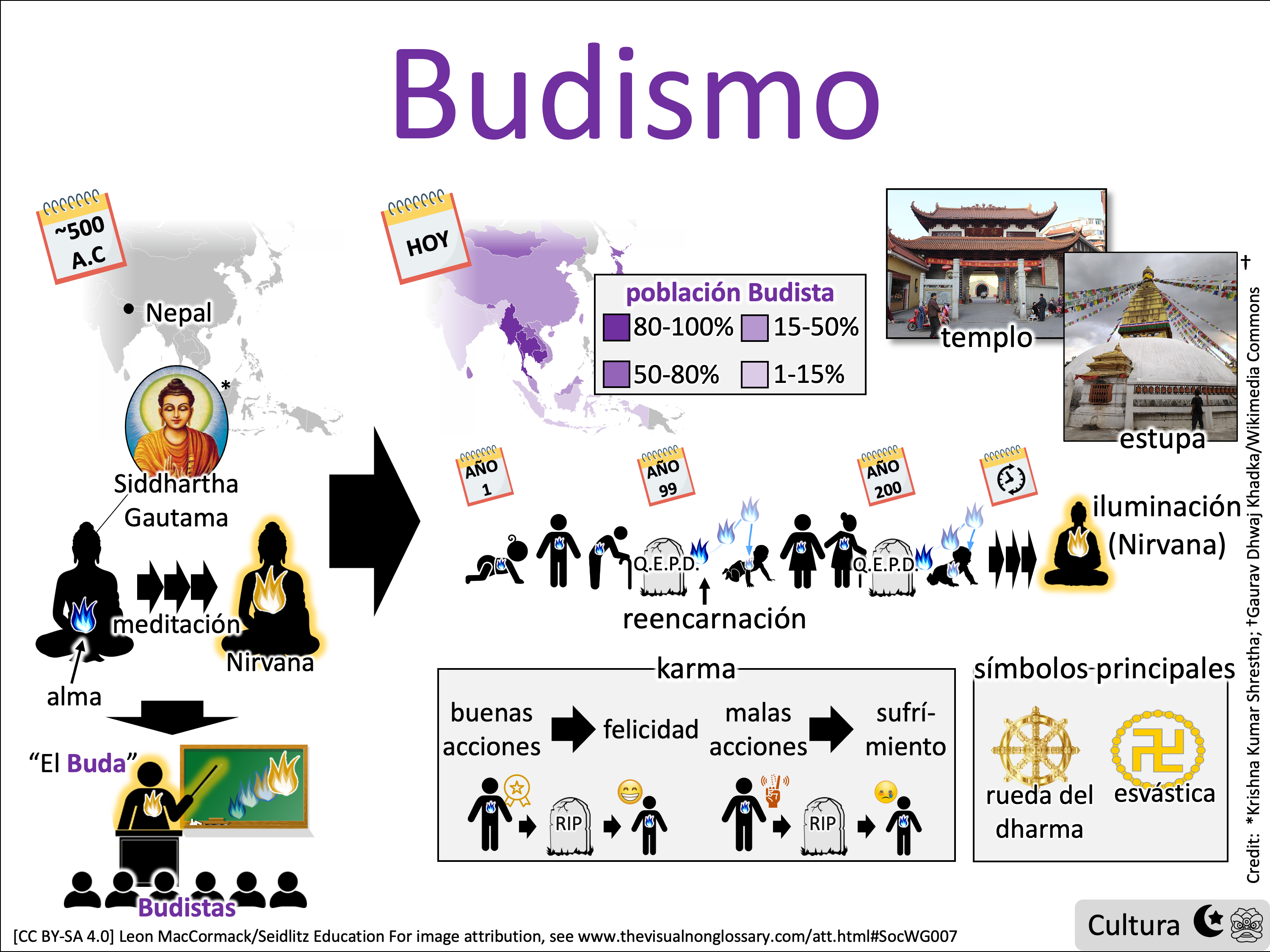
- Siddhartha Gautama dejó su vida de lujo para buscar la iluminación
- El Budismo enseña sobre el karma y la reencarnación
- El Camino Óctuple y las Cuatro Nobles Verdades guían las acciones budistas
- El Budismo se expandió por la Ruta de la Seda y se mezcló con otras culturas
- El Budismo se practica en muchos países hoy en día
EXTENDING THE DISCUSSION
After the observational question, randomly call on one or more students to share what they or their partner answered. Then ask the class, “Did anyone notice…?” using the suggestions above or anything else you’ve noticed.
After the observational question, randomly call on one or more students to share what they or their partner answered. Then ask the class, “Did anyone notice…?” using the suggestions above or anything else you’ve noticed.

Students might wonder:
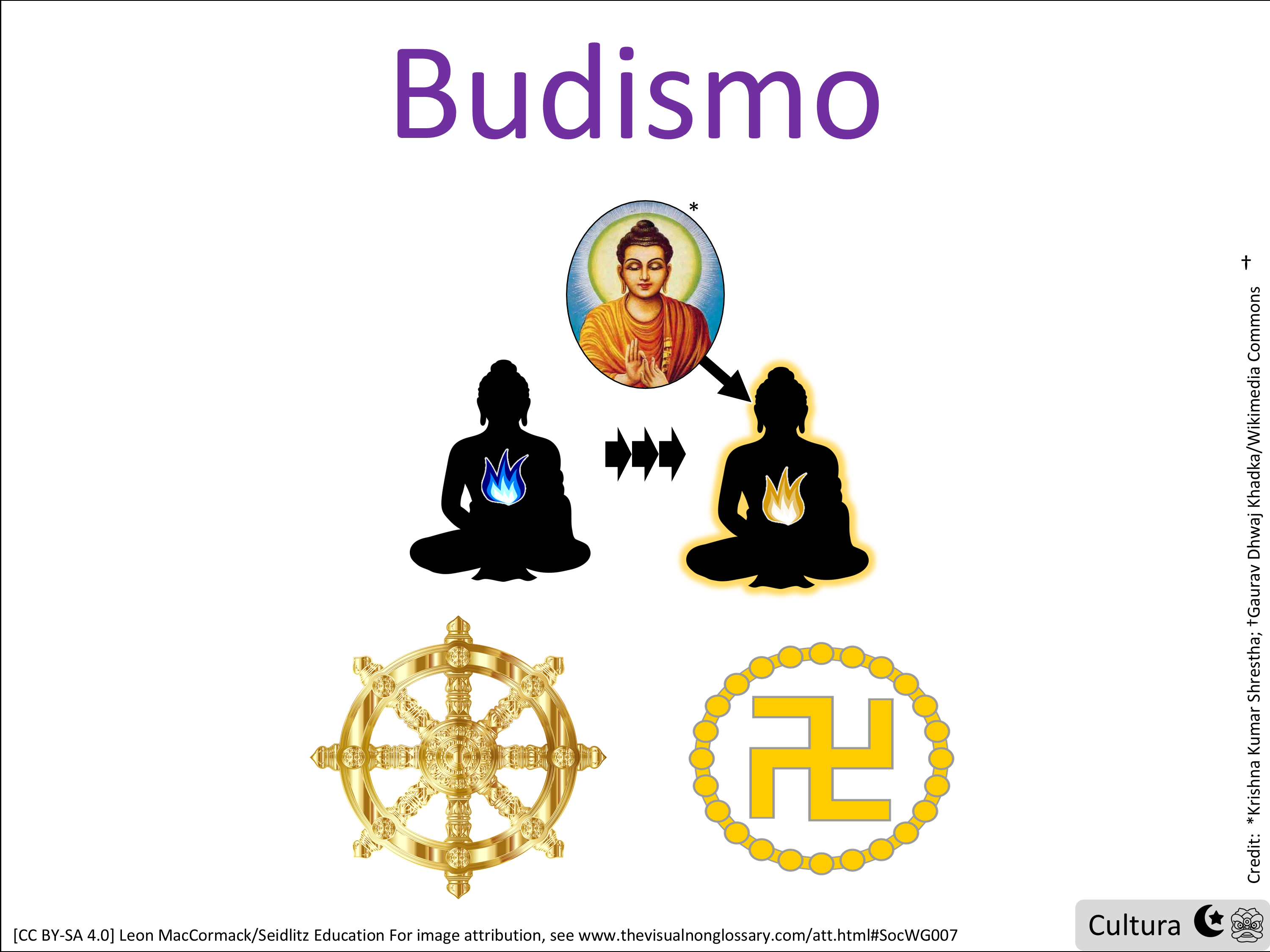
- ¿Qué representa la rueda del Dharma?
- ¿Por qué hay un mapa que muestra la expansión del Budismo?
- ¿Cómo se pueden practicar juntos el Budismo y el Shintoismo?
- ¿Qué significan las Cuatro Nobles Verdades y el Camino Óctuple?
- ¿Por qué hay un símbolo de esvástica en la visual, y qué significa en el Budismo?
EXTENDING THE DISCUSSION
After students have shared what they notice, ask the class, “Did anyone wonder…?” using the suggestions above or anything else you might think is interesting or relevant to the lesson.
After students have shared what they notice, ask the class, “Did anyone wonder…?” using the suggestions above or anything else you might think is interesting or relevant to the lesson.
Example student responses
To the observational question, ¿Cuáles son las creencias del Budismo?
LOW-LEVEL
Las creencias del Budismo son entender el sufrimiento, el karma y alcanzar el Nirvana.
HIGH-LEVEL
Las creencias del Budismo incluyen la idea de que la vida está llena de sufrimiento, pero se puede alcanzar la paz siguiendo el Camino Óctuple y comprendiendo el deseo y el karma. Estas enseñanzas vienen de la experiencia de iluminación del Buda y guían a las personas hacia el Nirvana.
RESPONDING TO RESPONSES
Emphasize and celebrate each student’s use of the key vocabulary to support a culture of “no wrong answers.”
Emphasize and celebrate each student’s use of the key vocabulary to support a culture of “no wrong answers.”