
We can determine if a value makes an inequality true by evaluating the inequality using operations.
How do you know if a value satisfies an inequality?
I know if a value satisfies an inequality by...
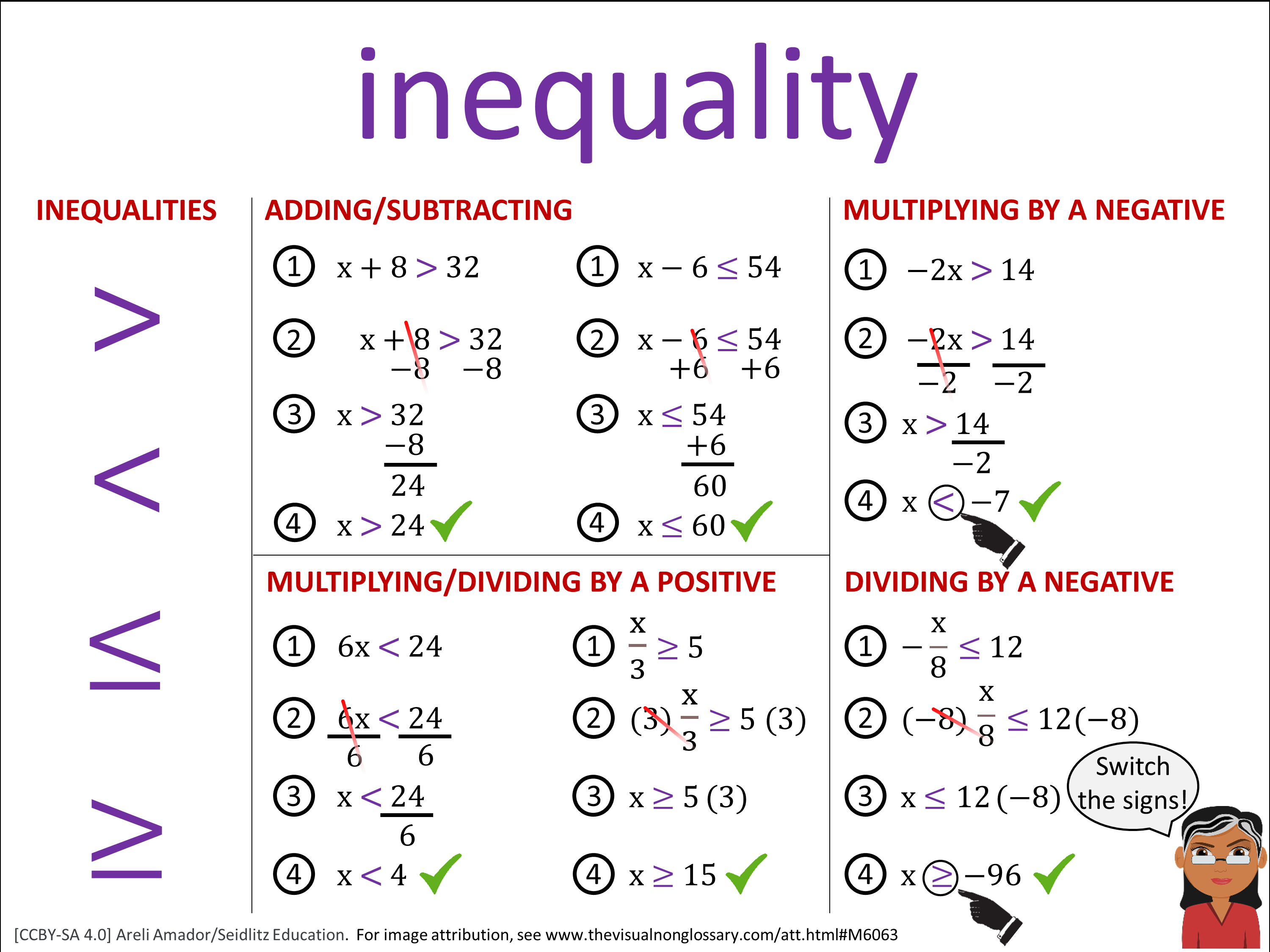
By studying this visual, students might:
- Inequality symbols like >, , ≥, and ≤ are used Adding or subtracting values doesn’t change the inequality sign Multiplying or dividing by a positive number keeps the inequality sign the same Multiplying or dividing by a negative number flips the inequality sign A character at the bottom says “Switch the signs!” when dividing by a negative
- Adding or subtracting values doesn’t change the inequality sign
- Multiplying or dividing by a positive number keeps the inequality sign the same
- Multiplying or dividing by a negative number flips the inequality sign
- A character at the bottom says “Switch the signs!” when dividing by a negative
- Why do we need to flip the inequality when multiplying or dividing by a negative?
- What happens if we forget to switch the sign?
- Can an inequality ever use an equal sign?
- Why do positives and negatives affect the inequality differently?
- Can the inequality symbol flip more than once in a problem?
Extending the Discussion
- After randomly calling on students, if there is anything from this list that was not mentioned, then ask the class, "Did anyone notice...?"
- After students have shared what they notice, ask the class, "Did anyone wonder...?" using the suggestions above or anything else you might think is interesting or relevant to the lesson.
Structured Conversation Prompts
What is an inequality?
An inequality is...
How is an inequality different from an equation?
An inequality is different from an equation because...
How do you know if a value satisfies an inequality?
I know if a value satisfies an inequality by...
Example Student Responses to the Observational Question
An inequality is a math problem with the “greater than” or “less than” sign.
An inequality is a math sentence that compares values and can use symbols like greater than or less than, showing that one side isn’t always equal to the other.
Responding to Responses
Emphasize and celebrate each student's use of the key vocabulary to support a culture of "no wrong answers."
Structuring Student Conversations
Have students list observations from the visual as a warm-up, then use the Q-SSS-A process to guide small-group conversations. In the slide decks, brackets can be moved to prepare the structured conversation. In the example to the right, students will be instructed: Q-SSS-A.
- To put a thumb up, then lower their hand when they are ready to answer the question
- To share with their elbow/shoulder partner, and that the student with the darkest shoe will share first
- That they will be randomly called on after the conversation
Here is an example of structuring a conversation with Q-SSS-A.
Note: the inferential question is the same as the language objective. It is recommended that students answer the inferential question in a small-group discussion before answering it individually as the closure or exit ticket of the lesson.
Structured Reading
To explore how different operations change an inequality and how that helps you check your answer
- A situation where you must flip the inequality sign
- The difference between solving equations and inequalities
- A symbol that shows a comparison
- An example of solving an inequality
- Something that affects whether a number works in an inequality
What do you have to pay attention to when solving an inequality?
When solving an inequality, I have to pay attention to...
Structuring the Reading
Communicate the purpose of reading to the students and instruct them to make a note every time they see something on the PAT ("Pay Attention To") list. How you have students note items on the PAT list is up to you. This could include:
- Putting an asterisk in the margin
- Underlining text that supports the PAT list
- Putting a comment in the margin
Follow the reading with the post-reading discussion. Structure this discussion using the Q-SSS-A process just like the structured conversations in this lesson.
Note: you might find the relational question is better discussed before or after the reading. This depends on whether the relational question is directly related to the reading or might make connections across units.
Differentiating the Reading
You will notice that three different reading passages are provided with this lesson. Look at the shapes in the top-left of each passage to determine the grade level.


In a class with students at diverse reading level proficiencies, you can give the appropriate reading passage to different students, while having all students follow the same PAT list and post-reading discussion.